
 Family Run U.K. Business
 Over 85 000 Customers!
 Selling Chicken Coops Since 2009
 Pay in 3 interest-free instalments!
Looking After Your Coop or Run
As with most outdoor wooden products, the lifespan of your coop or run can be significantly extended by taking a few simple, practical steps.
The guidance below reflects the same advice we would give if you asked us directly.
It’s based on many years of experience, real-world use, and feedback from thousands of customers, and it’s intended to help keep your coop in good condition and your hens safe, comfortable, and healthy.
Protecting and maintaining the timber
Your wooden coop or run is supplied with a base coat of preservative.
This provides initial protection against rot and insect attack, helping to protect the timber itself while also giving it its base colour.
The timber we use is chosen for its suitability for outdoor use and natural durability. However, like all outdoor wooden products, further treatment is an important part of long-term use.
Once in use outdoors, applying an additional protective treatment to the external surfaces makes a noticeable difference over time and is well worth the effort.
A good-quality exterior wood preservative or stain helps protect against rain, UV exposure, and general weathering.
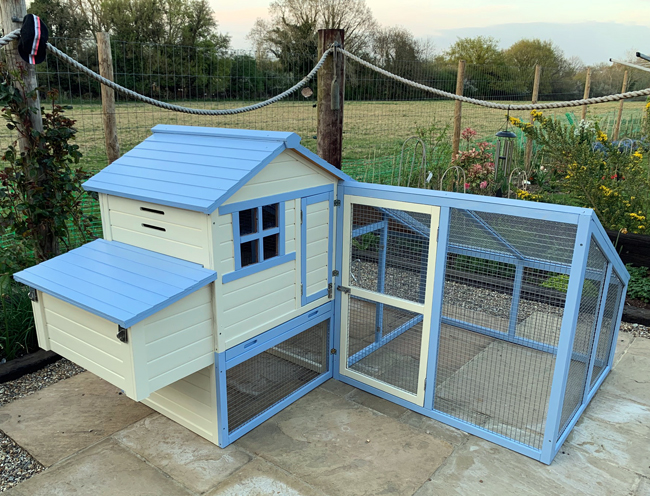
We also recommend treating the undersides of the roof panels, as these areas are more likely to be exposed to condensation during colder months.
As a general guide, treating your coop within the first year and then reapplying every 12 to 24 months, depending on exposure and conditions, helps maintain protection and appearance.
Some owners prefer to apply the first full treatment straight away while the coop is still clean and dry, while others choose to wait until late summer or early autumn.
Both approaches work well and largely come down to personal preference.
If no further treatment is applied, the base coat will gradually fade, and the timber will weather more quickly.
For external surfaces, widely available exterior wood treatments such as Cuprinol or Ronseal are commonly used.
For internal areas, a water-based, breathable, animal-safe wood treatment is recommended, as this allows moisture to escape while reducing condensation-related issues.
Lubricating metal parts
Locks, hinges, and roof stays benefit from occasional lubrication. Keeping these parts lightly lubricated helps them move freely and reduces wear over time.

A light spray of a general-purpose lubricant, such as WD-40, is usually sufficient. This is particularly helpful in damp or cold conditions, where metal parts can otherwise stiffen or seize.
If hinges or roof stays are allowed to seize, there is a risk of forcing or damaging the roof panel when opening it.
Applying a small amount of lubricant around once a month is usually enough for most outdoor settings.
Always ensure your hens are not inside the coop while lubricating, and wipe away any excess product afterwards.
Positioning your coop
Where your coop is positioned plays a major role in how well it performs outdoors.
We recommend placing the coop in a sheltered location, protected from prevailing wind and driving rain.
In the UK, storms with strong gusts are common and can place strain on coops that are exposed or poorly positioned.
This is not just about protecting the coop itself. Your hen may be inside at the time.
During periods of particularly severe weather, it can be sensible to move any run covers temporarily until conditions improve.
It is also worth checking that doors are not facing directly into the prevailing wind, as driving rain can be blown underneath during storms.
A common mistake we see is positioning the coop tightly against a wall, fence panel, or in a corner to try to provide shelter.
While this can seem sensible, these areas often become cold spots in winter with very little air movement.
Poor airflow and trapped cold, damp air significantly increase the likelihood of condensation and surface mould forming inside the coop.
Allowing space around the coop for gentle airflow, even in a sheltered spot, makes a big difference during colder months.
Cleaning, airflow and routine coop care
Regular cleaning is essential for maintaining a healthy environment inside your coop.
We recommend cleaning out the coop regularly and using a suitable disinfectant on internal surfaces.
Any wet or soiled bedding should be removed promptly and replaced as needed.
Food and water should never be placed inside the coop and should always be positioned outside.
Always use an animal-safe disinfectant and allow all surfaces to dry fully before replacing bedding.
We use a simple 50/50 mix of white vinegar and water, as it is inexpensive, easy to use, and very effective for routine cleaning.
Using the mixture in a spray bottle also makes it easier to reach corners, joins, and other harder-to-access areas.
Used diluted and allowed to dry fully, this can help remove surface mould and residues, and reduce the likelihood of surface mould returning as part of regular cleaning.
Pay particular attention to corners and the undersides of roof panels, as these are naturally cooler areas where moisture can collect, and cleaning is often overlooked.
Good airflow is just as important as cleaning when it comes to managing moisture.
Whenever the weather allows, it is a good idea to open doors and, where fitted, lift roof panels so the coop can dry out fully.
This is especially important after periods of wet or damp weather.
During colder, damper months, condensation can naturally form inside an unheated coop if airflow is restricted.
If moisture is allowed to linger, surface mould can develop on internal timber surfaces.
By cleaning regularly and maintaining good airflow, the risk of mould developing is greatly reduced.
Preventing capillary action on roof panels
During prolonged wet weather, rainwater can sometimes be drawn under the roof edging by capillary action.
This may appear as damp patches on the underside of roof panels, particularly near the edges.
The roof panel is the most exposed part of the coop, taking the full impact of rain, wind, and sun throughout the year.
Taking a small extra step to protect the roof is inexpensive and can make a noticeable difference to long-term durability.
By applying a thin bead of clear exterior-grade silicone between the roof panels and decorative edging, you create a clear barrier that stops the rainwater from being drawn in under the edging and so stops capillary action


We have tested several felt-compatible sealants and found the following two brands to perform very well, with this one proving the easiest to apply in most situations.


Running a small line of sealant along the underside edge of the roof panel can also create a simple drip line, allowing water to fall away rather than wick back into the panel.
Treating the underside of roof panels with a breathable, water-based wood stain or sealer is also a relatively low-cost and highly effective way to add extra protection.
Taken together, these simple steps go a long way towards protecting one of the hardest-working parts of the coop.
Foxes and other predators
If your rabbits or guinea pigs are kept outdoors, protection from foxes and other animals is an essential consideration.
In the UK, foxes are common and represent the greatest risk to hens.
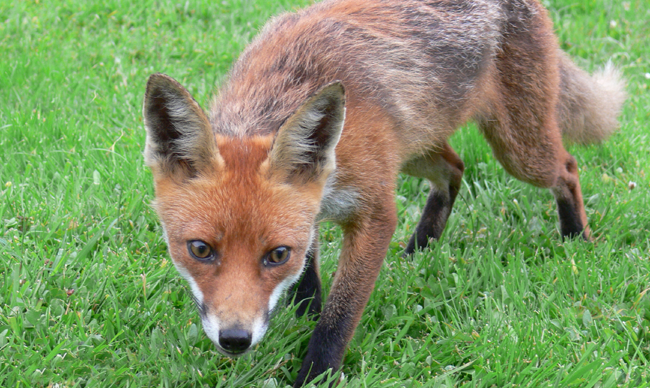
While we use thicker timber, strong wire, and secure fixings, no wooden coop can be guaranteed to be completely predator-proof.
Our coops are built to a higher standard than many others in this price range, but a determined fox can still cause significant damage while attempting to gain entry.
Good positioning, secure fixings, and sensible daily and nighttime routines all play an important role in reducing risk.
If you know foxes frequent your property, or are likely to do so, we do not recommend keeping rabbits outdoors overnight when fox activity is typically highest.
At night, always ensure hens are securely locked in and that doors, bolts, and catches are properly engaged.
Additional measures, such as placing the coop within a secure run or using extra ground-level protection, can provide further peace of mind.
We strongly recommend reading our dedicated fox-protection guide, which explains practical steps you can take to reduce risk further.
You can find our full fox-protection guide here: Fox protection guide.
Understanding the risks and taking sensible precautions is a key part of keeping outdoor hens safe.
Final thoughts
We hope you have found this guide helpful and easy to follow.
The guidance above reflects what we would recommend based on many years of experience and day-to-day use.
Looking after your coop or run is really just part of looking after your hens.
Keeping it clean, well-positioned, and properly maintained helps provide a safe, comfortable, and healthy home.
If you ever have questions or would like advice, just get in touch. We are always happy to help.
Have a question we didn’t answer?
If you still have a question and would like to speak with us, then just email:
We answer most emails within a few hours during working hours.
Pay in 3 interest-free instalments!
Over 85 000 Customers!
Family Run U.K. Business
Selling Chicken Coops Since 2009